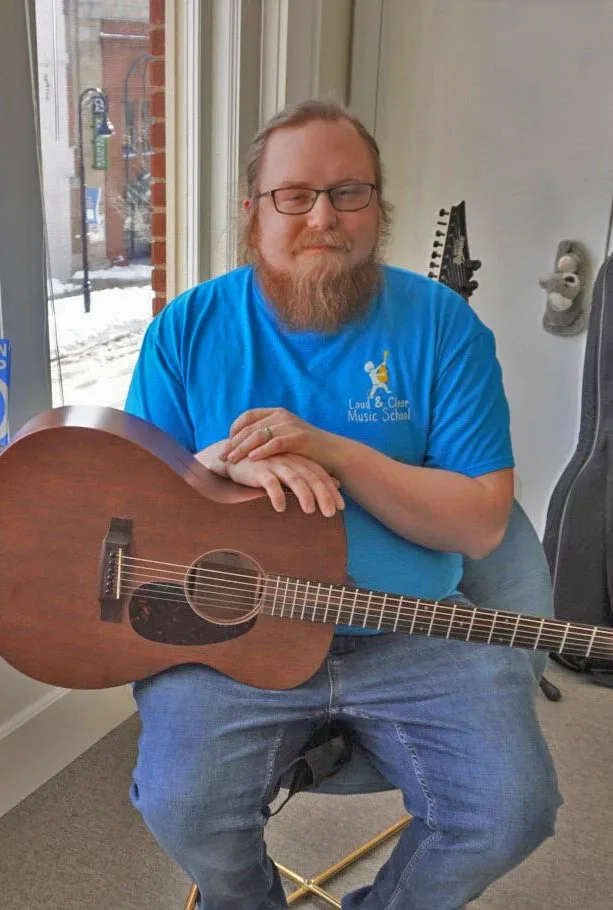
From Self-Taught Musician to Music School Entrepreneur
Host (David Martin): Mike Lowden, thank you for being on the show. Mike is the founder of Loud and Clear Music School in Ohio. His schools have grown to two locations with over 20 teachers and more than 800 students of all ages. What is truly impressive is that Mike started with no computer experience and no business background. He taught himself business by reading a book every week for 52 weeks straight. He now also runs a digital marketing agency, Nine Muses Digital, specializing in advertising for music schools across the country. Mike, how long have you been a musician?
Guest (Mike Lowden): I officially started at 11. My dad played guitar, and although he was busy supporting the family, I remember listening to music and really wanting to learn. I bugged him until he showed me a basic scale—natural notes on the first three frets. Looking back, I think he just wanted me to stop bugging him, so he challenged me not to come back until I could play it fast. I spent the whole summer practicing on a guitar that was way too big for me, but I locked into it and never really stopped.
Host (David Martin): Did you take formal lessons, or was it mostly self-taught at first?
Guest (Mike Lowden): My older sister was the type to try everything for two weeks and quit, so my parents assumed I would be the same. I didn’t get my own appropriately sized guitar for a year, and lessons didn’t start until a year after that. As a guitar player, I had an advantage over many pianists because I could immediately learn the songs I was listening to by using online tabs.
The Path to Professional Performance and Teaching
Host (David Martin): When did teaching become part of your plan?
Guest (Mike Lowden): It actually wasn’t on my radar initially. By 13 or 14, I knew the guitar was what I wanted to do for a living. I accepted that I might be a broke musician living in a studio apartment as long as I could play. I was gigging in punk bands at 13 and touring with older musicians by 16 or 17.
Host (David Martin): Did you go to college for music?
Guest (Mike Lowden): I went to Berklee College of Music in Boston for a while to study jazz. Eventually, I left because I didn’t want to be $150,000 in debt with a jazz degree when performance gigs rarely require a piece of paper. I came back to Ohio, taught private students, and worked at a few local music schools to pay the rent. I eventually fell in love with teaching.
Entering the Business: The $700 Partnership
Host (David Martin): How did you transition from teacher to owner?
Guest (Mike Lowden): I was teaching at a brand-new school, and I kept bringing ideas to the owner about how we could improve. He eventually suggested I become a partner. I bought into the business for $700, which was a lot of money to me then, and it took me eight months of “sweat equity” to pay it off. We started with about 30 students.
Host (David Martin): That’s a young age to start. How did you learn the business side?
Guest (Mike Lowden): My partner handled finance while I handled operations and people-facing tasks. When he eventually decided to return to the corporate world for a steadier salary, the school was plateaued at about 150 to 200 students. I took over the reins and realized I had to teach myself the fundamentals. That’s when I started reading one business book a week.
The “Inflow vs. Outflow” Breakthrough
Host (David Martin): How did you break past that 200-student plateau?
Guest (Mike Lowden): I focused on the fundamentals: inflow versus outflow. I realized our churn was matching our inflow, so we weren’t growing. I got serious about the numbers. Retention is just as important as marketing. I also improved our marketing offers. Even moving from “no offer” to a “decent offer” was a game-changer.
Innovative Staffing: Shift-Based W2 Employment
Host (David Martin): Your approach to paying teachers is quite unique in this industry. Can you explain your shift-based model?
Guest (Mike Lowden): Most schools pay per lesson, but we bring teachers on as W2 employees who work on set shifts. If a student cancels or there are gaps in the schedule, the teacher still gets paid. This gives them stability and a reliable paycheck.
It also gives us a competitive advantage for growth. If a new student needs a specific time that leaves a gap for the teacher, I can book it because I am already paying for that teacher’s shift. Even if I eat the cost for a few weeks, it allows us to be more flexible and fill the schedule faster.
The “Shadowing” Hiring Process
Host (David Martin): With W2 employees and set shifts, your hiring process must be rigorous. How do you vet your teachers?
Guest (Mike Lowden): Everyone is amazing for the first six weeks, so I’ve learned to extend the hiring process. We have a probationary period that includes two interviews and a shadowing phase. Applicants shadow a vetted teacher I trust, and that teacher reports back to me. If they are texting during a lesson or late to training, it’s a red flag. About 25% to 30% of people don’t make it through this process, but it brings me peace of mind.
Marketing Lessons and Return on Investment
Host (David Martin): What is the most effective marketing strategy you’ve found?
Guest (Mike Lowden): Don’t let your current email list collect dust. Reaching back out to families who once inquired but didn’t sign up is the most effective no-cost strategy. A single back-to-school email might gain you a few students who stay for years, making that email worth thousands of dollars in lifetime value.
Host (David Martin): You also mentioned the importance of “payback period.” What do you mean by that?
Guest (Mike Lowden): Return on Ad Spend (ROAS) is great, but cash flow is real. If I spend $500 to gain $2,000 in revenue, that’s a 4:1 return. However, in music lessons, that $2,000 comes in over a year. If your payback period is eight months and you stack too many of those investments at once, you can run into negative cash flow months even while growing.
The Mission: Creating More Creatives
Host (David Martin): How do you define success now that you have 800 students?
Guest (Mike Lowden): My goal is to make more creatives in the world because I think that makes the world a better place. Whether it is through music or art, I want to give people the happiness that creativity brings. Success is having systems that allow us to reach more people and help them win.
Host (David Martin): Where can people find you if they want help with their digital marketing?
Guest (Mike Lowden): You can find me at 9musesdigital.com. I help music schools with the “dorky” backend stuff like media buying, tracking, and optimizing ads so they can focus on their mission.